

AI has left the chat
The most influential AI may be that which we hardly notice

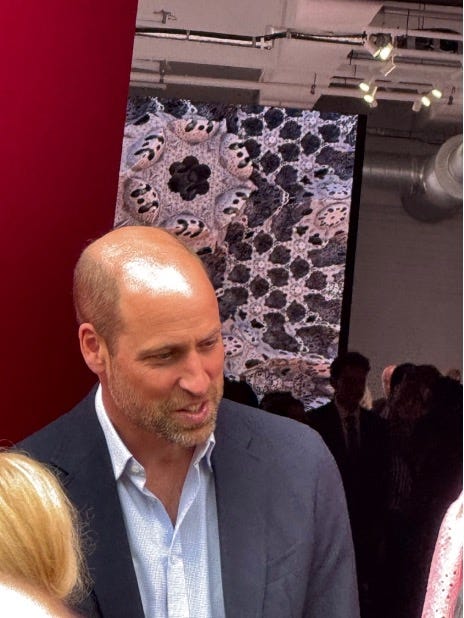
Prince William, with Diana Award recipients, SXSW London
Last week at SXSW London 2026, I was interviewed by Jessica Hamzelou of MIT Technology Review. She wrote an article on our session: Are AI chatbots making us lose control of our brains? The short answer is yes, if we can’t focus on our goals, do what we ought to be doing, or pursue those things that deeply matter to us.
If you’re not familiar with SXSW, it began in Austin in 1987. The conference features inspiring human stories, speculative visions of the future, technology, film and music. This year, in its second year in London, it drew attendees from 77 countries. But one theme overshadowed all others: the ubiquity of AI.
The conference was exciting, and standing in line to get into the venues was an opportunity to meet other people. And waiting in line paid off: I got to see Michelle Obama, who, along with her brother Craig Robinson, talked about taking a leap of faith giving up high-paying jobs to pursue jobs with a purpose (Michelle, from a corporate law firm to working in city government; and Craig, from high finance to becoming an assistant basketball player).
And sometimes fate deals you lucky cards. I happened to be standing in the right place at the right time, and then suddenly there was Prince William in front of me. He was there for The Diana Awards, which honors young people who made significant contributions to society.
At SXSW, the promises and threats of AI surfaced in conversations about nearly every aspect of human life: education, national security, ethics, governance, IVF, childhood, advertising, music, art, and even love. One of the takeaways is how fast AI has become embedded in our world—much of the time without our awareness. One day AI felt like a niche technology. And then we blinked our eyes, and now suddenly, it’s part of everyday life.
One of the most thought-provoking ideas at SXSW came from Will Abbey who pointed out that AI has left the chat. In the chat we issue prompts and get responses. But as many of us already know, AI has been moving into our phones, wearables, cars, homes and workplaces. It’s sensing us, reacting to us, and even influencing us. And much of the time we barely notice it.
When AI is out of the chat, it becomes invisible, and we have less control. Invisible AI has changed the power dynamics between humans and machines. Rather than us issuing prompts to AI, AI increasingly prompts us, and subtly, sometimes without our awareness, it’s shaping our behavior.
For example, my sleep tracking ring presents data of my sleep –the amount of REM, deep sleep, light sleep, how many times I awoke, latency to fall asleep, and it gives me an overall sleep score. I realized that it had influenced my mood and behavior. If the sleep score was high, I inferred that I must have slept well and powered through the day even though I felt off. If the sleep score was poor, then my mood changed to reflect the score. I now wait till the end of the day to look at my sleep score.
Another example of how AI is influencing our behavior came from Manon Dave at SXSW. Along with musician will.i.am, he designed the generative AI system used in Mercedes-AMG cars. Rather than use traditional feedback signals like beeps and buzzes, music adapts to how you drive, conveying parts of music tracks as you brake, accelerate, and steer. It raises the question: how might personalized sound tracks affect how we drive? Could people become conditioned to drive in ways that generate music that they enjoy? What if speeding up creates our favorite sounds? But can AI be designed with personalized feedback that encourages safe driving behavior, e.g., when we speed, what about having discordant tones play? What safeguards need to be introduced?
Not everyone at SXSW was optimistic about AI. Financial Times AI editor Madhumita Murgia argued that despite the grand vision that AI would improve humanity, AI is largely controlled by a few companies who mostly use it for profit and productivity. She called for more democratic oversight so that AI can be directed toward public benefits, ranging from deciphering ancient texts to accelerating medical breakthroughs.
The conference also featured grand visions of the future. Architect and filmmaker Liam Young presented a provocative proposal in which ten billion people live in dense urban environments while vast portions of the planet are allowed to recover and rewild. It sounds crazy, but that’s what sci-fi can do—allow us to imagine alternative futures.
But the most immediate challenge is not the distant future. It is the AI already surrounding us.
When we adopted the internet and smartphones, we knew we were adopting them. AI is different. Increasingly, it arrives embedded within the products and services we already use. We do not always make a conscious decision to adopt it.
The real question is not whether AI will influence us, but whether we will recognize that influence and retain the agency to resist it when necessary. With my sleep tracker, I finally noticed that it was affecting how I interpreted my own body. The same may happen if AI influences how we drive, shop, work, and make decisions. And what happens when AI shapes behavior through our environments rather than through explicit instructions? And what happens when it becomes deeply intertwined with those things we value in our culture, like music, art, health and relationships?
The first generation of AI waited for us to ask questions. The next generation is quietly shaping our perceptions, interpretations, and decisions while remaining largely invisible. The challenge is no longer whether AI can influence us—it already does. The challenge raised at SXSW is how to ensure that it serves our best interests when we may not even notice its presence.
************************************
You can read more about the effect of algorithms on our attention in my book Attention Span.