

Designing for human connection
What ancient Roman technology can teach us about building community

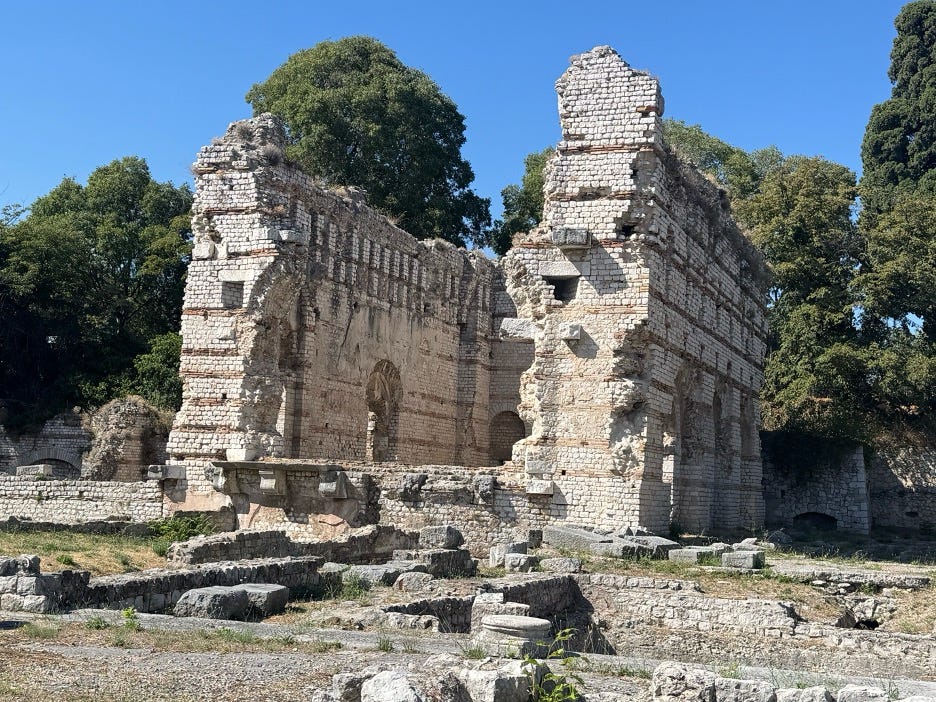
Roman Thermal Baths in Nice, France
I’m in the south of France now during an intense heat wave. Aside from the sweltering heat, the area is breathtaking: the shimmering Mediterranean Sea, the foothills of the Alps in the distance, clear blue skies, and, in some places, fields of lavender.
The Romans knew a good thing when they saw it, and in the 1st century B.C., they settled this region, what is now the Côte d’Azur and Provence.
I visited the remains of Roman thermal baths in what had been the capital of the Roman province “Alpes Maritimae” called Cemenelum, what is now the city of Nice. During one of the hottest weeks of the summer, I found myself wondering why anyone would willingly spend hours each day in heated communal rooms. Then I understood why. I learned that the baths weren’t just about hygiene; they were about social connection.
The Romans were brilliant engineers. They built aqueducts that carried fresh water, in some places for over a hundred miles. They developed ingenious heating systems for the Roman baths that circulated hot air under the floors and through the walls.
But they also understood something we’ve forgotten today. The Romans knew the importance of social life in society and were masters of social engineering. They designed their built environment to encourage people to meet.
For many Romans, bathing was a daily ritual, and a slow process. Bathers moved from warm rooms to hot rooms (the caldariums) and then on to cold rooms. There was no rushing in and out. The design of the baths encouraged people to remain, to encounter one another repeatedly, and to converse.
Bathing was not just about cleanliness. For the Romans, the thermal bath was the hub of social life. Citizens went to the baths not just to cleanse, but to meet others, hear the latest news, gossip, talk about politics, and listen to public readings.
The baths connected people of all social classes, and there, status in Roman society didn’t matter so much. The physical space, the heat, the water, and the ritual of bathing created a temporary equality.
The Romans didn’t leave sociability to chance. It was woven into daily routines. The forum, the city center, wasn’t just a marketplace but was the place where people met, did business, discussed current events. The daily ritual of shopping at the market also became a place for socializing. Landmarks like fountains and temples were designed into the city to create gathering spots, where people could naturally engage with others.
Modern cities, by contrast, are designed around efficiency, and not for meeting others. Lingering is not encouraged by design and, in fact, some commercial districts impose a fine for loitering. A shopping mall optimizes consumption, not conversation. Supermarkets are designed for us to shop and leave as fast as possible and self-checkout gets us out even quicker. The design choices we experience in our everyday lives prompt us to move fast, buy what we need, and go home.
There are certainly places where people still gather, like at farmers’ markets, parks, libraries, community centers, but one needs to be intentional to visit them. Casual encounters have become the exception rather than the default.
The Romans moved slowly through their public spaces. They strolled in plazas, listened to speakers, lingered at fountains, and spent time at the baths. But we increasingly do the opposite. The National Bureau of Economic Research found that over the last 30 years, people walked 15% faster and spent about half as long lingering in public spaces. Rather than pausing to meet others, we’re rushing past each other, barely giving others an acknowledgement or even a smile. We optimize for speed.
Smartphones certainly get in the way of truly being with other people. But smartphones accelerated the problem, they didn’t create it. The decline in public sociability started decades earlier, as documented by the sociologist Robert Putnam in his book Bowling Alone.
Long before smartphones appeared, we had already begun designing cities and changing daily routines that eliminated opportunities for casual social encounters.
But there are some architects who have designed sociability back into cities.
Danish architect Jan Gehl spent decades studying why people linger in some public spaces and hurry through others. His insight, described in his book Life Between Buildings: Using Public Space, was simple: people stay where there are reasons to. Like the Romans, he created sociability by design. Pedestrian streets encourage people to walk slower because they don’t need to avoid cars. He also designed public squares and outdoor cafes for people to spend time. Copenhagen became a model for cities around the globe.
In today’s world, social media platforms have become, in some ways, the digital equivalent of the Roman forum. But we have lost something essential. We don’t create deep and meaningful connections in such online spaces as we would if we met others face-to-face. Digital platforms are designed to capture and direct attention, but physical environments can be designed to cultivate true connection with trust, empathy and community.
From Roman baths and forums to Copenhagen’s pedestrian streets, these all demonstrate that architecture can shape our social interactions. Physical design can be a powerful mechanism to foster social engagement, as the Romans so brilliantly knew. At the same time, design can just as easily discourage it, and that includes technology design.
The Romans thus understood something we have forgotten: a physical space, if designed right, can encourage connection. But somewhere along the way, we have engineered sociability out of our built environment in favor of speed and efficiency.
But Jan Gehl and other urban planners show that it doesn’t have to be this way. We can design public areas differently. We can bring back spaces that encourage us to meet and gather, making it socially acceptable to spend time there and meet strangers.
Sociability isn’t something people lack. It is something our environments can either cultivate or erode. When we design cities and buildings that invite people to linger, gather, and belong, we make human connection over devices the easier choice.
***********************************
You can learn more about how we can take back control over our tech in my book Attention Span.